


AUB hosts first Lebanese Mathematics Day, uniting national mathematical community
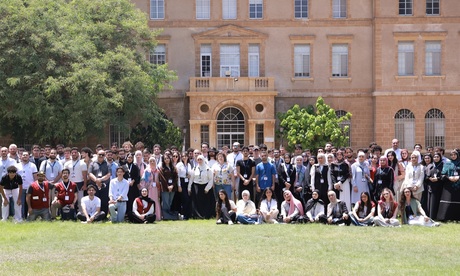
The American University of Beirut (AUB) hosted the first Lebanese Mathematics Day, bringing together 341 participants from more than ten universities, high schools, industry, and the international mathematical community for a full day of talks, workshops, poster sessions, and discussion on the AUB campus.
AUB’s Center for Advanced Mathematical Sciences (CAMS), directed by Professor of Physics Jihad Touma, organized the event in collaboration with the university’s Department of Mathematics and the Faculty of Arts and Sciences (FAS).
Collaborators also included the AUB Student Mathematics Society and student representatives from AUB, the Lebanese American University, Notre Dame University, Saint Joseph University, and the Lebanese University.
The event was conceived as a national forum to connect students, educators, researchers, alumni, and professionals. A distinctive feature of the initiative was its student-led nature: throughout the academic year, student representatives from several Lebanese universities worked alongside faculty and staff to develop the program and organize activities.
The day's program included 40 talks organized into 11 parallel sessions, 20 posters, four workshops, an invited lecture, a panel discussion, and a mathematics trivia contest, alongside a career exploration and networking area open throughout the day.
In his opening address, Dr. Ahmad Sabra, associate professor in the Department of Mathematics, outreach coordinator at CAMS, and lead organizer of the event, reflected on what draws people to the discipline. "Although we belong to different universities, institutions, schools, and are at different stages of our careers, today we come together as one community united by the love of mathematics," he told participants gathered in Bathish Auditorium.
Sabra emphasized that the event was designed to be open and welcoming, noting that students invited to present talks and posters were deliberately not required to submit original research. "We wanted to give students a platform to speak freely about a mathematical topic that genuinely interested them, to explain why they found it meaningful, and to share their curiosity with others," he said. He added that a guiding principle behind the day was the conviction that "there is no academic community without its students," describing Lebanese Mathematics Day as an event built not simply for students, but with them.
The idea for the event was first proposed nearly four years ago at CAMS and developed over time through smaller outreach activities organized with FAS colleagues and students from universities across Lebanon. Sabra credited a committed group of student organizers with turning that long-standing aspiration into reality, noting that they reviewed submissions, communicated with speakers, built the event website, prepared the scientific program, and coordinated logistics while continuing their own studies through a particularly difficult year.
Students who addressed the opening ceremony echoed that sense of ownership. Manar Darsa, a student at the Lebanese University and member of the organizing committee, described the project as one of the most meaningful experiences of her university journey. "This event was about much more than organizing a conference," she said. "We wanted to build a community where mathematics becomes a bridge that connects students throughout Lebanon."
Georges Sakr, a student organizer from AUB, pointed to the wider significance of the gathering. "Despite the divisions and difficulties around us, we are still capable of building strong academic communities in Lebanon," he said, expressing hope that the day would become "the starting point of a lasting national mathematics community."
The scientific program spanned a broad range of topics. The four morning workshops, led by faculty from four Lebanese universities, addressed mathematical modeling of waves and natural hazards, the mathematics of risk, inquiry-oriented learning in differential equations, and the mathematics of turning a swinging rope into a digital musical instrument. The 40 contributed talks brought together undergraduate and graduate students, alumni, faculty, and professionals across topics ranging from cryptography and quantum error correction to actuarial modeling, partial differential equations, and applications of mathematics in medicine and public health.
The poster exhibition featured 20 presenters, including high school, undergraduate, and graduate students. A jury of three faculty members awarded prizes for the best posters to Alwaled Al-Gburi (first place) and Laura Al-Halabe (second place). The mathematics trivia contest drew 176 participants across a preliminary electronic round and a written final.
The invited lecture, delivered by Professor Assaf Kfoury of Boston University and titled "Will Artificial Intelligence Put Mathematicians Out of Work?" examined the evolving relationship between artificial intelligence and mathematical research, concluding that mathematicians' roles are expanding rather than diminishing. A closing panel discussion brought together mathematics graduates who have pursued diverse academic and professional paths in Lebanon and abroad to share perspectives on graduate studies and careers.
The event was supported by 46 student volunteers and by sponsors including the Faculty of Arts and Sciences at AUB, the Lebanese Society for the Mathematical Sciences, and Librairie Antoine. Organizers described the inaugural gathering as the foundation for what they hope will become an annual national celebration of mathematics.
"I sincerely hope that this is only the beginning," Dr. Sabra said. "I hope Lebanese Mathematics Day becomes a tradition that our mathematical community looks forward to every year."
