


AUB School of Business hosts roundtable on restructuring Lebanon’s banking sector
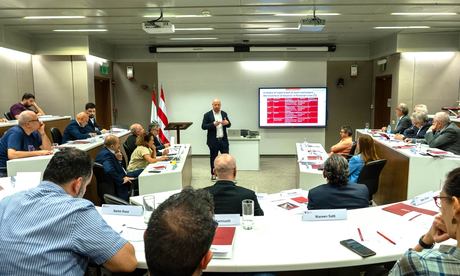
The Suliman S. Olayan School of Business (OSB) at the American University of Beirut (AUB), through its Business Practice and Policy Initiative (BPPI), hosted an expert roundtable titled “Restructuring Lebanon’s Banking Sector: Global Standards, Local Realities.” The event gathered economists, bankers, and academics to explore viable pathways for restructuring Lebanon’s paralyzed banking system amid one of the country’s most severe financial crises.
The BPPI, a newly established initiative within OSB, bridges academic knowledge with policymaking to advance evidence-based reform, turning research into actionable insights that support Lebanon’s recovery and strengthen governance.
The roundtable brought together around 30 participants representing the banking, finance, and academic sectors. Among the distinguished participants were Saad Azhari, chairman of BLOM Bank sal; Dr. Marwan Barakat, group chief economist and head of research at Bank Audi; Dr. Nassib Ghobril, chief economist and head of the economic research and analysis department at Byblos Bank sal; Dr. Mounir Rachid, president of the Lebanese Economic Forum and former senior advisor to the Lebanese minister of finance; Alia Moubayed, economist and public policy practitioner; Dr. Nisreen Salti, associate professor in the Department of Economics at AUB; Dr. Ali Awdeh, chief economist and director of the research department at the Union of Arab Banks; Nicolas Chikhani, financial and banking expert; Dr. Walid Marrouch, professor of economics and associate dean of graduate studies and research at the Lebanese American University; Dr. Salim Baz, assistant professor of finance at the Adnan Kassar School of Business at Lebanese American University; Dr. Ishac Diwan, professor of practice at the Department of Economics at AUB; and Dr. Ali Abboud, assistant professor at the Department of Economics at AUB.
Opening the roundtable, Hussein Chokr, knowledge to policy expert at BPPI, framed the banking crisis as not only financial but also social and ethical—an event that crippled the economy, destroyed livelihoods, and eroded public trust. He emphasized that restructuring should restore justice, accountability, and confidence in the financial system.
Professor Yusuf Sidani, dean of OSB, welcomed participants and reaffirmed AUB’s role as a space where research drives real-world solutions. Reflecting on OSB’s legacy in shaping Lebanon’s economy, he underlined academia’s responsibility to engage meaningfully in rebuilding national institutions.
Professor Neveen Ahmad, BPPI director, noted that the roundtable was based on a policy report by Dr. Mohamad Faour, assistant professor of finance at OSB; Dr. Sami Geadah, fellow at the Issam Fares Institute for Public Policy and International Affairs at AUB and former alternate executive director at the International Monetary Fund; and Dr. Ibrahim Jamali, associate professor of finance at OSB, whose research provided the foundation for the discussion. She reiterated BPPI’s mission to connect scholarship with practice to promote financial recovery.
Dr. Jamali began by assessing the current state of the Lebanese banking sector and reviewing best international practices in bank restructuring, drawing on experiences from several crises, including Greece, Cyprus, and Italy. He then discussed the guiding principles from this cross-country analysis and explained the paper’s main contribution. He emphasized that the paper shifts the discussion from aggregate solvency to a bank-by-bank evaluation, aligning with valuation and asset-quality review practices in restructuring.
Dr. Geadah outlined the main proposals advanced by stakeholders to resolve the Lebanese banking crisis. Geadah noted that while existing plans agree on the crisis’ origins and the need for a healthy banking system, they differ on how to resolve it, particularly on deposit treatment, the use of bank equity to pay deposits, the use of state assets to resolve the crisis, the clawback of pre-crisis interest and dividends, and whether to target illicit gains. He emphasized that the resolution strategy should rely on individual bank data while adhering to core resolution principles.
Relying on publicly available financial statements from 21 banks, covering data dating back to 2020, Dr. Faour showed that the crisis stems mainly from exposures to the Central Bank rather than government debt. His simulations indicated that fully recognizing losses on banks’ balance sheets would render all banks insolvent, even in optimistic scenarios. However, a bail-in of 83 percent of US dollar deposits—while protecting small savers—could restore solvency in most banks under moderate stress, though under severe assumptions roughly half the system would remain insolvent.
Moderated by Hussein Chokr, the floor opened for a discussion session among experts from the financial and academic community. Representatives of the banking sector stressed that the crisis originated from state and Central Bank mismanagement rather than commercial banks and called for a coordinated national plan to gradually restore deposits, confidence, and economic activity. They described the crisis as systemic in scope, encompassing macroeconomic collapse and currency depreciation, and called for a unified, state-led framework supported by realistic financial instruments, including potential use of gold reserves.
Some participants discussed the feasibility of current recovery measures, warning that many government plans remain unimplementable. They urged practical steps focused on liquidity restoration through Central Bank reserves and gold revaluation gains rather than reliance on international assistance. Restoring trust, they agreed, is the cornerstone of recovery, requiring joint contributions from the government, Central Bank, and banking sector. They further emphasized that the crisis is one of confidence rather than accounting. They called for adopting mechanisms similar to full-deposit guarantees used internationally to reassure savers and prevent capital flight.
Academic voices broadened the discussion to include social and structural implications, highlighting the shared responsibility of banks, depositors, and regulators. They warned that Lebanon’s growing reliance on cash risks deepening exclusion and poverty and called for greater transparency, accountability, and clarity regarding the “Lollar” and future currency frameworks. They also pointed to fundamental flaws in the pre-crisis financial model that encouraged unsustainable high-yield placements with the Central Bank. They stressed that bank restructuring—not merely compensating losses—is vital to restore the sector’s productive role and recommended leveraging Lebanon’s gold reserves to provide liquidity post-restructuring rather than to finance the process itself.


