


Triumphant Merkel Re-elected Party Chief with 97 Percent
إقرأ هذا الخبر بالعربية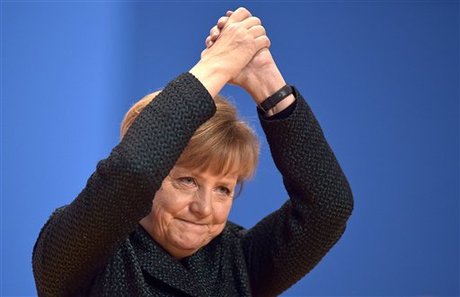
German Chancellor Angela Merkel was re-elected unopposed on Tuesday as chief of her conservative party at a triumphant congress that celebrated her role as Europe's most powerful leader.
From the Ukraine conflict to Europe's debilitating financial crisis, Merkel said her policies as the head of Europe's biggest economy promoted security and stability and lived up to Germany's responsibilities in the world.
After a vigorous speech punctuated by bouts of enthusiastic applause, delegates crowned Merkel head of the Christian Democratic Union (CDU) for the eighth time with 96.7 percent, a result she called an "overwhelming vote of confidence."
The result was slightly down on the last vote in 2012 however.
Merkel, who is nearing a decade in power, stressed that Germany and its EU neighbors needed both economic growth and budget discipline to shore up their future global role.
Merkel, 60, said Germany under her government was a prosperous and respected country, with a successful industrial base, strong social and environmental standards and low unemployment.
"The CDU has been good for Germany," said Merkel, pledging however not to rest on her laurels and face the challenges of the future.
These, she said, ranged from boosting investment in roads, railways and broadband networks, to pushing on with a renewables energy shift and tackling a fast aging society.
Merkel said Germany's future lay within a strong, united Europe and warned that the financial crisis that almost sank the eurozone was not yet fully surmounted, even if it had been brought under control.
Days after telling France and Italy to do more to get their public finances in order, Merkel again urged all of Europe to respect the rules it had set itself to win back confidence after the crisis.
Berlin's insistence on economies sticking to the EU's Growth and Stability Pact was not a matter of "German fussiness", she told around 1,000 delegates at the start of the two-day congress in the western city of Cologne.
"If, in the end, we fail to adhere to what we resolved to do in this crisis, then we'd gamble away confidence," she said to thunderous applause.
"And that would not be good for Europe."
While many southern Europeans, feeling the pain of the eurozone economic and financial crisis, despise Merkel for preaching tough reforms and austerity, Germans mostly see her as a safe pair of hands steering the country largely unscathed through the years of turmoil.
Merkel still notches up poll figures that are the envy of other world leaders -- the latest survey by public broadcaster ARD indicated an approval rating of 67 percent.
And 56 percent of Germans want Merkel to serve a fourth term as chancellor from 2017, according to a poll by the Bild am Sonntag newspaper.
Turning to another challenge for Europe Merkel said she was convinced the Ukraine conflict and the standoff with Russia could be resolved diplomatically, even if it would require patience.
"We will need staying power, but I am convinced that we can do it, that we must do it," she said.
Merkel has been in frequent contact with Russian President Vladimir Putin during the crisis and pledged that she and Foreign Minister Frank-Walter Steinmeier would miss "no opportunity" in trying to seek a diplomatic solution.
As Merkel spoke, a ceasefire appeared to be largely holding along the frontline in the ex-Soviet republic's war-shattered east, but planned peace talks in the Belarusian capital Minsk have been delayed.
Merkel, a Lutheran pastor's daughter and trained quantum physicist who was raised in the former communist East Germany, has headed the party since 2000 and has been chancellor since 2005, with no obvious successor in sight.
CDU conventions have largely become celebrations of the election-winning chancellor, dubbed "Mutti" or Mummy by Germans and often hailed with shouts of "Angie!" by supporters of the party that is now sometimes mocked as the "club for the election of the chancellor."
But critics charge that Germany's once vibrant political culture has been suffocated by the rein of the mighty Merkel, whose year-old "grand coalition" government has absorbed her vanquished center-left rivals the Social Democrats, giving both a crushing majority against a tiny leftist opposition.
