


A European experiment that in September showed particles moving faster than the speed of light has been exposed as a mistake due to a faulty wire connection, the U.S. journal Science said Wednesday.
"A bad connection between a GPS unit and a computer may be to blame," said the report on the magazine's website section Science Insider, citing "sources familiar with the experiment."
 Full Story
An astronaut attempting to visit recently discovered planetGJ1214b would land in hot water -- literally, U.S. scientists say.
Researchers at the Harvard-Smithsonian Center for Astrophysics said they have identified an entirely new kind of planet, dominated not by rock, gas or other common materials, but water.
 Full Story
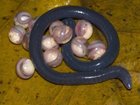
Researchers digging through mud in northeast India have discovered a new family of legless amphibians in a rare scientific breakthrough detailed in a study released on Wednesday.
The family of burrowing, tailless creatures was identified by scientists working for five years in remote Indian states including Sikkim, Arunachal Pradesh and Nagaland.
 Full Story
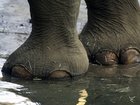
Paleontologists working in the United Arab Emirates have uncovered elephant footprints that are seven million years old, making them the oldest of their kind and possibly the longest preserved track way in the world.
The find, reported on Wednesday in the British journal Biology Letters, was made at a site called Mleisa 1, in the UAE's Baynunah Formation, a geological outcrop dated to the Late Miocene.
 Full Story
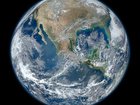
A Japanese construction firm claimed Wednesday it could execute an out-of-this-world plan to put tourists in space within 40 years by building an elevator that stretches a quarter of the way to the moon.
Obayashi Corp claims it could use carbon nanotube technology, which is more than 20 times stronger than steel, to build a lift shaft 96,000 kilometers (roughly 60,000 miles) above the Earth.
 Full Story
Fruit seeds stored away by squirrels more than 30,000 years ago and found in Siberian permafrost have been regenerated into full flowering plants by scientists in Russia, a new study has revealed.
The seeds of the herbaceous Silene stenophylla are far and away the oldest plant tissue to have been brought back to life, according to lead researchers Svetlana Yashina and David Gilichinsky of the Russian Academy of Sciences.
 Full Story
A stark theme emerged from an annual scientific get-together in Vancouver: the world must be helped to believe in science again or it could be too late to save our planet.
Science is "under siege," top academics and educators were warned repeatedly at the American Association for the Advancement of Science meeting as they were urged to better communicate their work to the public.
 Full Story
Edinburgh Zoo on Monday started daily tests to pinpoint the best time for its pair of giant pandas, given to Scotland by China, to try to produce a cub.
Zoo-keepers are collecting urine and vaginal samples from female panda Tian Tian, whose name means Sweetie, to check her estrogen levels.
 Full Story
China's National Energy Administration plans to beef up safety at nuclear power plants after months of assessments and inspections in the wake of Japan's Fukushima disaster.
The administration said in a statement on its website that 13 research and development projects involving the China National Nuclear Corp. and other state-run companies and research institutions should be completed by 2013.
 Full Story
Scientists say preliminary tests indicate radiation didn't cause lesions and other symptoms associated with sickened or dead ringed seals found along Alaska's northern coast last year.
The National Oceanic and Atmospheric Administration says a screening of tissue samples from both healthy and sick ice seals and walruses showed no radiation levels that would have directly caused the symptoms.
 Full Story
