


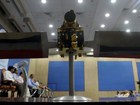
India's government has cleared plans to put an orbital probe around Mars next year to study the red planet's climate and geology, a report said Saturday.
The mission would mark another step in India's ambitious space program, which placed a probe on the moon three years ago and envisages its first manned mission in 2016.
 Full Story
A newly discovered Australian spider measuring little more than a millimeter in length has been named after celebrated British scientist and broadcaster David Attenborough, reports said Saturday.
The minuscule arachnid, which is found only on Horn Island, in Australia's Torres Strait, was named prethopalpus attenboroughi by its discoverers, according to Alec Coles, head of the Western Australian Museum.
 Full Story
NASA said Thursday all was well ahead of its nail-biting mission to Mars, with its most advanced robotic rover poised to hunt for clues about past life and water on Earth's nearest planetary neighbor.
On a two-year journey to seek out signs of environments that once sustained life, the landing of the Mars Science Laboratory and the largest and most sophisticated rover ever built, Curiosity, is set for 1:31 am August 6 (0531 GMT).
 Full Story
The recipe for the perfect sandcastle? A delicate balance of 99 percent sand and one percent water, say physicists who have given new meaning to mixing work and play.
For their contribution to science, researchers in Amsterdam and Paris spent hours building beach sand columns in their laboratories to come up with a complicated mathematical formula for a stable and long-lasting sandcastle.
 Full Story
Dust and aerosol pollution from Asia travels across the ocean and sullies the air in the United States and Canada, possibly worsening the effects of climate change, a NASA-backed study showed Thursday.
About half of the aerosol particles in North America come from foreign sources, and most are just from naturally occurring dust rather than from burning coal or other fossil fuels, said the research published in the journal Science.
 Full Story
Drilling of the seabed off Antarctica has revealed that rainforest grew on the frozen continent 52 million years ago, scientists said Thursday, warning it could be ice-free again within decades.
The study of sediment cores drilled from the ocean floor off Antarctica's east coast revealed fossil pollens that had come from a "near-tropical" forest covering the continent in the Eocene period, 34-56 million years ago.
 Full Story
The biggest, worst space rover ever built for exploring an alien planet is nearing its August 6 landing on Mars, and the U.S. space agency is anxious for success despite huge risks.
A popular Internet video by NASA called "Seven Minutes of Terror" depicts the high drama involved with the first-ever attempt to use a rocket-powered sky crane to lower the car-sized machine gently onto the surface of the Red Planet.
 Full Story
Even as Man's output of Earth-warming CO2 has risen, so has the capacity of plants and the oceans to absorb it, scientists said Wednesday, but warned this may not last forever.
Carbon storage by land and sea, known as carbon sinks, has more than doubled in the past 50 years from about 2.4 billion tons in 1960 to some five billion tons in 2010, said a study in Nature.
 Full Story
One day 370 million years ago, a tiny larva came to a sticky end when it plunged into a shrimp-infested swamp and drowned.
Unearthed in modern-day Belgium, the humble bug now looks set to plug a giant gap in the fossil record.
 Full Story
Heartened by a glimpse of what may be the Higgs boson, scientists at the CERN physics lab are smashing particles with new vigor in a quest to understand why matter has mass and other riddles of the natural universe.
Rather than the end of the line, the July 4 unveiling of a boson with Higgs-like characteristics opens new scientific frontiers, enthuse researchers at the Large Hydron Collider near Geneva.
 Full Story
